
 all resources & insights
‘Your Most Important Work Is Always Ahead of You’—How to Live Life in Crescendo
The challenges of leadership can seem plentiful: lack of trust, fizzled communication, chaotic changes, a monsoon of technological innovation. But it doesn’t have to be overwhelming. In this recap of a conversation between Doug Conant and Cynthia Covey Haller, the two experts discuss how you can reframe your thinking, achieve actual success in a noisy world, and hit all the high notes as a leader.
Your Most Important Work Is Always Ahead of You
It’s impossible to dive into Cynthia Covey Haller’s work without remarking on the legacy of her late father and collaborator, renowned educator and author Dr. Stephen R. Covey. When Haller’s co-panelist Doug Conant went through a bevy of mid-career challenges decades ago, it was Stephen R. Covey and Blaine Lee who helped him turn a corner. Conant says their guidance and mentorship helped him “see my leadership challenge as one of service as opposed to being one of achievement.”
Today, Haller’s teachings continue Covey’s work. She recalls a pivotal moment from her early life when she, “foolishly made the mistake of saying, ‘Hey Dad, are you gonna write anything as good as The 7 Habits [of Highly Effective People]?’ And he was kind of insulted by that and said, ‘You know, I wrote that in 1989. What do you think I’ve been doing for the last 40 years?’” It’s a moment she looks back on with humor and fondness, as it became the impetus for the book she later co-authored with her father, Live Life in Crescendo.
The concept of living in crescendo comes from musical compositions. In sheet music, the crescendo symbol indicates where a song builds in volume and vigor. “If you’ve been to a concert and heard a crescendo, it’s powerful,” Haller says. Living in crescendo is similar. It’s the notion that life is dynamic and expansive, an ever-growing tapestry of successes, lessons, experiences, and influences. Her book’s subtitle sums it up well: “Your Most Important Work Is Always Ahead of You.”
Haller makes sure to define the opposite of a crescendo, a diminuendo: the point where the music begins to fade away. People who live in diminuendo may have experienced failure or rejection and “basically shut down” because of it, she explains. Her book challenges people to choose a crescendo instead, no matter what they’ve been through. “My father often talked about paradigms and how it’s like putting on a pair of glasses. It gives you perspective in everything you see if you have this crescendo mentality.”
People who think they can get better, often do.
See How Good You Can Get
The lesson of the crescendo continues to be timely and resonant for Conant, who says that Haller’s book helped inspire what he considers his most meaningful work to date: The Higher Ground Leadership Success System™ (HGLSS). The HGLSS is a step-by-step plan for leaders who want to set the tempo instead of merely reacting to it, and the system itself mirrors the gradual escalation of a crescendo, culminating in a grand finale of, “producing extraordinary results.”
In an ode to her own crescendo mentality, Haller made it her mission to finish writing Living Life in Crescendo, even though her father passed before it was fully completed. She searched for practical examples of people who continue to hit the high notes in life, despite their setbacks. During her conversation with Conant, she shares one story that didn’t make it into the book: the fascinating diminuendo-to-crescendo progression of former San Francisco 49ers quarterback and NFL Hall of Famer Steve Young.
When Young first joined the 49ers, he played backup for quarterback Joe Montana. Young waited in the wings while Montana won two Super Bowls and rose to fame as one of the most beloved football players in the nation. In 1991, Montana was injured and it was Young’s time to shine—or so he thought. The team didn’t perform well and the headlines were harsh. A once optimistic, hopeful Young morphed into a depressed, defensive version of himself.
One day on a return flight from visiting his brother, Young found himself seated next to Covey, who asked him how he was doing. Young, eager to commiserate about his misfortune, told him everything.
Covey listened intently and asked him about the leaders in his life. Young shared that the team’s owner, Edward J. DeBartolo Jr. and coach, Bill Walsh, really cared about the players and listened to what they had to say. He also spoke about Joe Montana as a mentor, not a rival. Covey took that in and offered him a reframe. Haller recalls: “My father said . . . ‘To be honest with you Steve, hearing about your owner, your coach, your mentor . . . you’re in a great position to make things happen.’” Then, Covey asked Young a question that broke through his hopelessness: “Do you want to see how good you can get?” It was that conversation that inspired Young’s crescendo. The following year, he earned the NFL’s Most Valuable Player (MVP) Award.
‘Go slow in order to go fast.’
Young’s story aligns with Conant’s observation that people who think they can get better, often do. Action follows belief. Still, Conant understands why Young initially felt so dejected. He warns that it is all too easy to acquiesce to a diminuendo mentality in a volatile landscape. Every day, he speaks with leaders who are overwhelmed with the speed of change and discouraged by the lack of trust and communication in the workplace. He tells these leaders to take a beat and reminds them that sometimes, you have to “go slow in order to go fast.”
Going slow, Conant says, requires staying grounded in your own leadership foundation—first by digging deep into the core of who you are and then by expanding your reach and influence based on that reflection. It’s the exact formula he teaches in his Higher Ground Leadership Success System.
Haller agrees: “Society tells us that we’re victims, that we can’t change, that we’re stuck in a rut, that we need to blame people.” Crescendo mentality, on the other hand, teaches that “you’re not a product of your circumstances, you’re a product of your proactive decisions.” The book explores the stages of life where the choice to fade into diminuendo or build up to crescendo are particularly common, such as midlife, which is when people often reassess their accomplishments, relationships, and regrets.
She tells the story of one man who suddenly found himself unemployed at 46, after years of running his own construction company. Despite what probably felt like a record scratch on his career, he chose to reinvent himself and enroll in law school. He was confident in his new path, but still wrestled with the idea of what could have been, and the weight of all the work that lay ahead. Fortunately, Haller says, the man was “determined that no matter what it took, he would continue to fight his doubts and fears and go forward.” At 50, he set up his new law practice.
The story serves as a lesson that living in crescendo won’t always feel balanced and harmonious. Composer Ludwig van Beethoven once said that “To play a wrong note is insignificant; to play without passion is inexplicable.” No one is immune to experiencing uncertainty. Mistakes will be made. Hardships will be faced. The goal is to keep playing through it all.
Resist ‘Been There, Done That’
Haller and Covey’s book explores another stage of life where the choice between diminuendo or crescendo is especially critical: at the height of success. It doesn’t matter how many accomplishments and accolades are on your resumé. Resist the urge to sit on your laurels and think “been there, done that,” Haller advises. She applauds Conant for his commitment to the crescendo. “You’ve been the CEO of different companies [yet] you’re still producing, you’re still contributing, [which is] a great tribute to your life.”
Conant adds that when leaders are at the pinnacle of success, they must challenge themselves “to pay forward our good fortune.” It’s a philosophy inspired by Viktor Frankl: “Between stimulus and response, there is a space. And in that space is our power to choose our response. In our response lies our growth and our freedom.” Conant carries this framework with him today as a student of leadership. He says the choice to continue moving forward and be proactive—while far from easy—is ripe with opportunities “that you never would’ve imagined.”
Life is a mission, not a career.
These opportunities, discovered within crescendo, are not self-serving pursuits. Haller shares an adage from her great-grandfather: “Life is a mission, not a career.” And she says a mission, “usually involves serving other people.” Conant backs her up. His entire Higher Ground leadership philosophy, including his 12 tenets of ‘leadership that works,’ is centered on putting people first; he believes you must honor the agenda of all parties before you can ever expect them to honor your agenda as a leader. ‘People-first leadership’ sets the tone and lifts your voice in an otherwise chaotic space. No matter your past, using your skills and abilities to help others is the key to your future. It’s the sound of a leader living life in crescendo.
Begin with the End in Mind
An audience member asks the panelists, “Are there any daily practices or rituals that activate a crescendo mindset?”
“Begin with the end in mind,” Haller says. Envision the life you want and choose small habits to support that vision. The options are limitless: Wake up with the sun, take a walk outside, check in on a loved one, read inspiring literature, listen to music and podcasts that move you, jot down a few things you’re grateful for each day. Whatever you do, develop incremental actions that support your dreams.
Conant’s book, The Blueprint: 6 Practical Steps to Lift Your Leadership to New Heights, echoes the importance of these habits. When he was CEO of Campbell Soup Company, he developed a practice of writing 10 to 20 notes every day on his long commute to work, thanking employees for their contributions to the company. “By the time I got to the office, I was filled with gratitude,” he recalls.
It’s this air of gratitude and service to others that preludes a crescendo. For those who need more direction about where to begin, Haller offers this advice: “Be introspective. Look at your talents and skills. You don’t have to be extraordinary to make an extraordinary difference in someone’s life.” Make sure to look inward, but don’t only look back, she adds. “My father always used this analogy that if you’re driving a car, don’t keep looking in your rearview mirror or behind you at what you left [otherwise] you’d eventually end up in a ditch.” There are some beautiful things ahead. Keep your eyes on the horizon and enjoy the music along the way.
____
Ready to Live Life in Crescendo?
Doug Conant has turned everything he learned running Fortune 500 companies, across five decades, into one life and leadership success system, organized around two pillars of DEPTH and REACH. The entire system is yours to explore with our FREE, 4-week email mini-course.
Additional Resources
- LinkedIn Learning Course: Finding Your Leadership Purpose with Doug Conant
- LinkedIn Learning Course: Finding Your Leadership Vocabulary with Doug Conant
- STEPS: A Leadership Course for Administrative Professionals
- The ConantLeadership Video Library featuring conversations with top leadership luminaries like Indra Nooyi, Bill George, Brené Brown, Amy Edmondson, and many more
- The ConantLeadership Blog: Find hundreds of resources on ‘Leadership That Works’
- The Leadership That Works Newsletter: A Monthly Roundup of the Best Leadership Resources from Around the Web
- Get the first chapter of The Blueprint: 6 Practical Steps to Lift Your Leadership To New Heights FREE
- Download the free companion workbook to The Blueprint
About the Author:  Vanessa Bradford, a featured contributor to ConantLeadership, is a freelance content writer and copywriter.
(Header Illustration by Centre for Ageing Better on Unsplash)

“Doug Conant is remarkable—and so is this work.“
– Stephen M. R. Covey
Author of The Speed of Trust
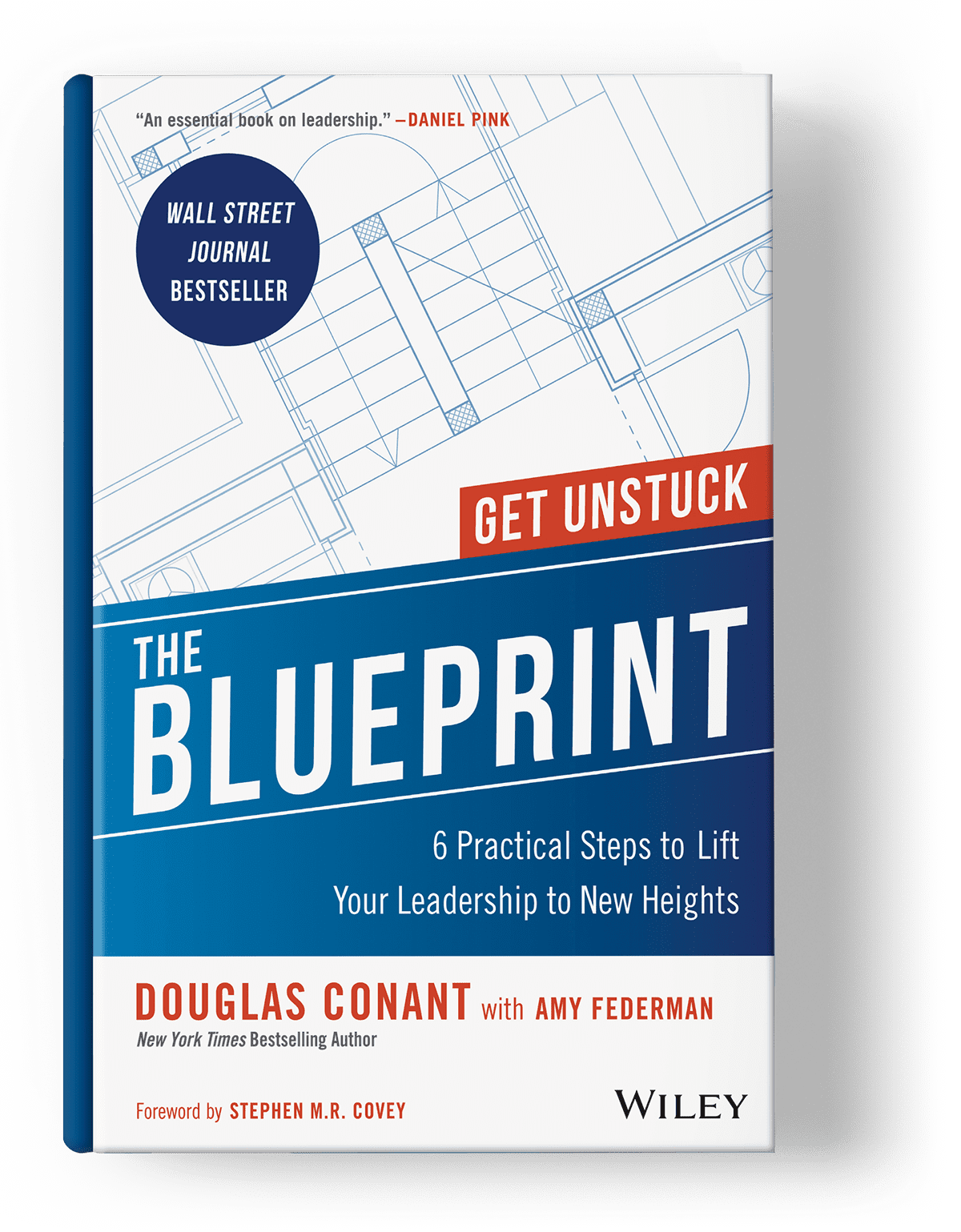
The Blueprint
6 Practical Steps to Lift Your Leadership to New Heights
By Douglas Conant with Amy Federman



Have Doug Speak at Your Event
Doug works collaboratively with event organizers to customize his material for each audience.