
 all resources & insights
3 Questions That Build Resilience – The Leadership That Works Newsletter
At ConantLeadership, we’re committed to lifelong learning and continuous improvement. In service to your leadership growth, in each month’s ‘Leadership That Works’ newsletter we curate a digest of resources from around the web to:
- Share actionable advice from top leadership luminaries
- Celebrate a range of viewpoints (inclusion is not an endorsement)
- Contextualize workplace trends through a leadership lens
- Support your personal development in life, leadership, & beyond
You can subscribe to our newsletter here.
Want to work with us to lift your or your team’s leadership to new heights? Drop us a line or talk to Emma Anthony, our Director of Leadership Programs.
New from ConantLeadership
Lessons from Getting Fired
In this new piece in our “Golden Anniversary” collection—a treasury of Doug’s thought leadership that has been updated to help you meet the current moment as we celebrate his 50 years in leadership—he shares three big lessons from when he got fired earlier in his career. Read an excerpt below or click through to read the full post.
1. Always offer to help. The very first words my outplacement counselor, Neil MacKenna, ever uttered to me were, “How can I help?” Sure, you might expect a first meeting with somebody in his position to begin that way. But those were the same words he said to me at the start of every single meeting afterwards. By beginning each interaction with a “how can I help” mentality, his earnest desire to be supportive shone brightly through our conversations.
This had a profound effect on me and led me to apply the same approach in my leadership journey. Let’s face it: people can tell when you’re not there for them. If you’re not listening, if you’re not sincere, it’s apparent. And if you don’t show up for people, why should they show up for you?
Too many leaders are so entrenched in their own work that they lose sight of the opportunity to connect with people. I discovered that the more I offered to help the people with whom I worked, and the more I gave them the energy to fight the good fight for our company, the more they did the same for me, and the more productive our relationship became. Get the full story here.
 Founder’s Corner: What’s Doug Enjoying?
A snapshot of resources that our Founder & CEO, Doug Conant, has recently found insightful and/or inspiring.
1. VIDEO: Jacob Collier Improvises with Orchestra LIVE
From Doug: “Absolutely loved this. Such inspiring creativity, a real masterpiece. Of course, I have a companion thought: In addition to mastering his craft of conducting, I’m certain Collier is also a master student of the craft of creating and conducting music. He deeply understands the fundamentals and then leverages them to improvise and create something beautiful. I find too many leaders today are chasing improvisation at the expense of first understanding the fundamentals. Be a true student of the craft of leadership. The more you study the fundamentals, the greater your ability to improvise and expand your reach as a leader. I guarantee it.”
2. ARTICLE: Job Interviews by Kate Bennis
From Doug: “Thoughtful and straightforward advice on approaching the interview process from a real pro. One great insight (among many) from the piece: ‘Rather than showing off, we can strive to show ourselves.'”
What Stays the Same in the Midst of Change
“Most leadership commentary is written from a short vantage,” so it doesn’t present the full picture of the longer view, says Vibhas Ratanjee in this Forbes piece on what leadership lessons endure across decades of “crisis and renewal” cycles. In conversation with ConantLeadership founder, Doug Conant, who Ratanjee interviewed for this piece, a few themes emerge. Yes, change is occurring at an alarmingly fast rate, but this only provides an opportunity for leaders to get more deeply “anchored in what does not move.” Ratanjee nicely articulates what stays the same, no matter what happens in the world: “People still want to be part of something that serves a purpose larger than the task in front of them. They are not built to be isolated. They are searching, still, for connection and for the sense that the life they are spending at work is a life worth spending.” The leaders who build sustainable success understand that high performance requires understanding these timeless principles. They are “not the ones who run fastest,” but, “the ones who know, with precision, what they will not let speed take from them.” Get the full story here.
3 Questions That Build Resilience
In this New York Times newsletter by Jancee Dunn, she shares strategies for building resilience in the midst of crisis or hardship, adapted from Martin Seligman, the director of the Penn Positive Psychology Center. Dunn shares that Seligman “has developed a three-part framework people can use to interpret life’s challenges: permanence, pervasiveness, and agency,” and she has created a question for each concept that she uses when “feeling out of control.”
Is this problem permanent? “Knowing that your problem has an end point can help you shift from a state of emergency to tolerance,” so it’s wise to ask yourself if an issue will still irk you “in five hours, five days, or five weeks.” If it’s likely to still be bothersome in five weeks, “then you can direct energy and resources toward dealing with it.”
Is this problem pervasive? “Sometimes a misstep or a crisis can cause us to generalize, drawing sweeping conclusions from one event.” To stop yourself from spiraling, ask yourself, “Is this problem really affecting every single aspect of my life? What areas remain unaffected and positive?”
Where do I have agency with this problem? “Agency, or the ability to take actions and make decisions that affect our lives,” is the most important factor in determining your resilience. So, ask yourself what is in your control, and you’re likely to find that there is “almost always” something that is within your power to do.
Get the full story here.
Leaders, Declare Your Beliefs
After conducting hundreds of focus groups to determine what shared practices unite the best leaders, Marcus Buckingham (along with his mentor Dr. Don Clifton) identified a handful of what he calls “demands,” or “actions that the most effective leaders demanded of themselves,” which are the focus of this piece in Chief Executive. Central to these “demands,” was the importance of the advice to “share your beliefs.” Buckingham explains, “one side of this demand was internal,” meaning good leaders “disciplined themselves to find time during the year to sit with their beliefs and clarify them.” And, “the other side of this demand was external,” meaning, “these leaders seemed to understand that the job of a leader was to play to an audience, and they couldn’t expect the audience to read their mind, or their heart.”
Research shows there is not one particular way to declare your beliefs: “Some leaders write a yearly letter to their people expressing their beliefs; some hold weekly meetings in which they ask their team to share real-world examples of the leader’s beliefs in action; some create badges and buttons to celebrate teammates who have lived up to the leader’s beliefs.” The possibilities are endless. Buckingham says, “the method doesn’t matter. What matters is that you, the leader, are explicit about what you believe.” Get the full story here.
**For more on this, explore our LinkedIn Learning course on “Finding Your Leadership Vocabulary,” which gives you the tools for discovering and articulating your leadership beliefs.
The AI Backlash Is Brewing
You may have heard the rumblings of a growing backlash against AI: The Pope published a 40,000+ word encyclical warning against the “risk of creating an inhumane and more unjust world” in the age of AI; multiple commencement speakers touting the technology have been loudly booed; Gallup polling shows Americans are vehemently opposed to building data centers that power AI in their neighborhoods.
For a closer look at what’s driving negative attitudes, this coverage in the Wall Street Journal does a good job of examining why, in the words of the three journalists who collaborated on the coverage, the “fast-growing industry has a faster-growing crisis,” as, “pollsters and historians say the souring of public opinion is all but unprecedented in its speed.”
The coverage points to a growing disconnect between some business leaders’ optimism about AI and students and young professionals’ anxiety about its impact on their career, their hobbies, and their ability to think critically for themselves. The journalists also report a rapid rise in AI’s “salience as a political issue, one that is shaking up routine re-election races and scrambling partisan battle lines.” Representatives from leading AI companies point to a PR issue, saying they need a “coordinated effort to highlight the benefits” rather than letting a “fear perspective” rule the day. Get the full story here.
(The WSJ version may appear behind a paywall for some users. You can also view the reprint of the article on MSN here.)
More from ConantLeadership
What Do Great Leaders Have in Common?
In Doug’s ongoing work training leaders across industries and experience levels, he’s developed a crystal clear point-of-view about the leadership behaviors that actually work. He’s found that the very best leaders approach their work in a way that is tough-minded on standards and kind-hearted with people. They are experts at doing both: skillfully marrying the ‘head’ and the ‘heart.’ Simultaneously, they prioritize people and performance. And they do so in ways that are humble, courageous, and authentic to who they really are.
Get the full story here.
3 Important Reasons Why Pressure Is a Privilege
Meeting our growth edge from time to time is necessary. Pressure naturally pushes us out of our comfort zone and invites us to grow. We may feel our throats tighten and our nerves heighten when faced with the sudden opportunity to pitch a dream client, or when a new, time-sensitive project falls into our lap. But that sensation of nervous energy can also be harnessed as excitement. What a gift that we can use our unique skills, insights, and convictions to move through a novel situation creatively. These pressurized conditions also sharpen our skills for the next challenge and improve how we lead in the spaces between. And if we do falter, as all leaders sometimes do, we’ll still be better for it. Get the full story here.
Highly Inspiring Quotes on Reaching Life & Leadership Goals
We recently updated one of our most popular quote roundups of all time with fresh content and new quotes to motivate and inspire you. Click here to get over 40 smart quotes from brilliant people across professions and spheres of influence.
April’s Leadership That Works Newsletter
In last month’s newsletter: A survival guide for chaos, the case for ‘reasonableness,’ how to measure resilience, clarity beats certainty, & more.
 About the Author: Amy Federman is ConantLeadership’s Director of Content and Editor in Chief, and co-author with Doug Conant of the WSJ bestseller, The Blueprint.

“Doug Conant is remarkable—and so is this work.“
– Stephen M. R. Covey
Author of The Speed of Trust
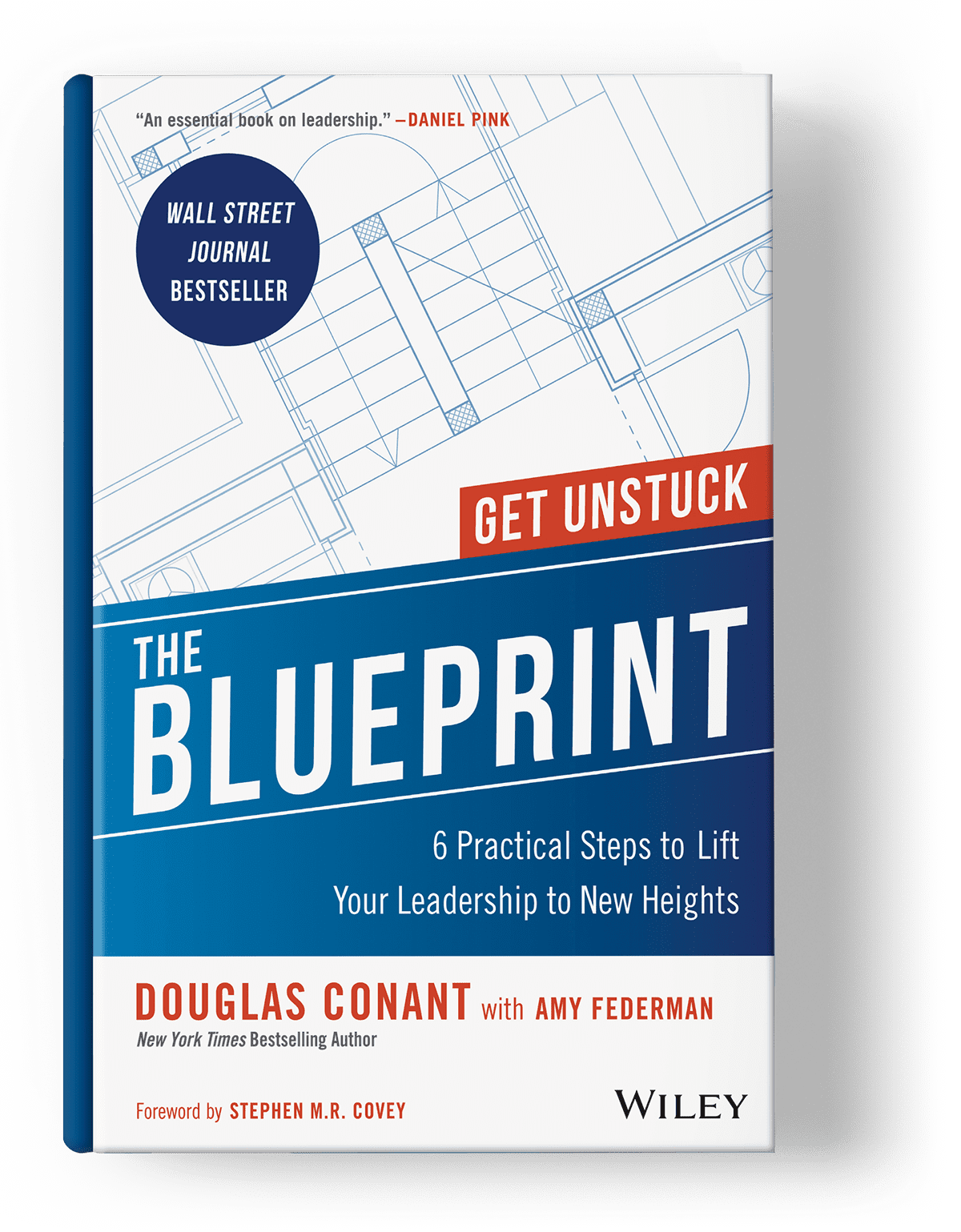
The Blueprint
6 Practical Steps to Lift Your Leadership to New Heights
By Douglas Conant with Amy Federman



Have Doug Speak at Your Event
Doug works collaboratively with event organizers to customize his material for each audience.