
 all resources & insights
‘Offer Yourself to the World’ – The Leadership That Works Newsletter
At ConantLeadership, we’re committed to lifelong learning and continuous improvement. In service to your leadership growth, in each month’s ‘Leadership That Works’ newsletter we curate a digest of resources from around the web to:
- Share actionable advice from top leadership luminaries
- Celebrate a range of viewpoints (inclusion is not an endorsement)
- Contextualize workplace trends through a leadership lens
- Support your personal development in life, leadership, & beyond
You can subscribe to our newsletter here.
Want to work with us to lift your or your team’s leadership to new heights? Drop us a line or talk to Emma Anthony, our Director of Leadership Programs.
In this edition of the Leadership That Works Newsletter: Offer yourself to the world; seek truth, not persuasion; how to make a product people actually care about; create small moments of recognition; pressure test your leadership message, and more.
New from ConantLeadership
Your Most Important Work Is Always Ahead of You
In this new recap of a conversation between Doug Conant and Cynthia Covey Haller, the two experts discuss how you can reframe your thinking, achieve actual success in a noisy world, and hit all the high notes as a leader. The way to do it, is to remember, “your most important work is always ahead of you,” which is a positive outlook that Haller calls living life “in crescendo.” The concept of living in crescendo comes from musical compositions. In sheet music, the crescendo symbol indicates where a song builds in volume and vigor. “If you’ve been to a concert and heard a crescendo, it’s powerful,” Haller says. Living in crescendo is similar. It’s the notion that life is dynamic and expansive, an ever-growing tapestry of successes, lessons, experiences, and influences.
One simple way to start living in crescendo is to, “begin with the end in mind.” Envision the life you want and choose small habits to support that vision. The options are limitless: Wake up with the sun, take a walk outside, check in on a loved one, read inspiring literature, listen to music and podcasts that move you, jot down a few things you’re grateful for each day. Whatever you do, develop incremental actions that support your dreams. Get the full story here.
 Founder’s Corner: What’s Doug Enjoying?
A snapshot of resources that our Founder & CEO, Doug Conant, has recently found insightful and/or inspiring.
ARTICLE: Living from the Inside-Out by Parker Palmer
From Doug: Here is a collection of thoughts from Parker Palmer that he shared as part of a commencement address at Naropa University in 2015. On a personal level, these thoughts speak to me. And I find them nicely aligned with our belief at ConantLeadership that, “the only way out is in.” Find the first of his six thoughts below and then click through to read the full post.
Excerpt: “My first suggestion is simple: Be reckless when it comes to affairs of the heart.
Now, before someone thinks I’m trying to corrupt America’s youth, what I mean is fall madly in love with life! Be passionate about some part of the natural and/or human worlds, and take risks on its behalf, no matter how vulnerable they make you. No one ever died saying, ‘I’m so glad for the self-centered, self-serving, and self-protective life I lived.’ Offer yourself to the world—your energies, your gifts, your visions, your spirit—with open-hearted generosity.
But understand that when you live this way, you will soon learn how little you know and how easy it is to fail. To grow in love and service, you must value ignorance as much as knowledge and failure as much as success. . . So cultivate beginner’s mind, walk straight into your not-knowing, and take the risk of failing and falling, again and again—then getting up to learn again and again. That’s the path to a life lived large in service of love, truth, and justice.” Get the full story here.
Analytics Are for Truth-Seeking, Not Persuasion
In a thought-provoking Harvard Business Review piece entitled, “Don’t Let AI Make Bad Analytics Worse,” writer Steven Tadelis imparts several tips for building “decision discipline” as a bulwark against letting AI amplify “flawed reasoning.” At the end of his list of tips for building decision discipline, he closes with the advice to, “Reward truth-seeking, not persuasion.” Tadelis explains, “The biggest barrier to better analytics is often not technical. It’s organizational. If teams are rewarded for proving that their initiatives worked, they’ll find evidence that they worked. If leaders punish bad news, analysts will learn to soften it.” To avoid the all-too-common scourge of people abusing technology tools in order to provide faulty evidence of what higher-ups most want to hear, “leaders need to create incentives for honest measurement.”
Tadelis says, “The cultural message should be clear: We do not run analysis to win arguments. We run analysis to make better decisions.” And he warns, “AI will give leaders more answers than ever before. Some will be valuable. Some will be wrong. Some will be technically accurate but useless for the decision at hand. . . AI will transform analytics by making answers abundant. But answers are not the same as evidence, and evidence is not the same as a better decision.” In this landscape of both more answers and simultaneously less clarity, “the managerial task” becomes, “not to slow AI down everywhere,” but “to add friction where the cost of being wrong is high, while letting low-risk analysis move faster.” Ultimately, Tadelis predicts that the companies who win will not be the ones “that ask the most questions,” but rather, “the companies that know which answers are good enough to act on.” Get the full story here.
How to Make a Product People Care about
“If you want to make something that people actually care about, you have to care about it yourself,” writes Joan Westenberg in this treatise on how to make products people want to engage with and purchase. Their paramount piece of advice may be obvious but it is too often overlooked: You must care deeply about what you’re making, “because if you don’t, then try as you might, it’ll come out in the final product.”
Westenberg observes that this need to pour care into your work, “has never been more pronounced. AI seems to be making everything from software to the written word all but disposable; and the temptation that comes with it is to make as much work as possible, while caring as little as possible, and doing it at scale.” This is a deeply flawed approach because customers are becoming more discerning as the marketplace is flooded with products that have been thoughtlessly spewed out using technology tools. Therefore, it becomes more important to be thoughtful. And Westenberg adds that whether or not people can always tell AI-generated content from human-generated content, “most folks have an almost supernatural ability to sense whether a creator actually gives a damn. We know when someone doesn’t care. We know when someone’s phoning it in.” And why should the customer care about your product if you don’t? Fortunately, “the good news is this: being deeply invested in the things you make, say, and do is a moat that few will bother to build.” Caring can be your greatest competitive advantage. Get the full story here.
Small Moments of Recognition Have Big Impact
“Employees want to feel valued, appreciated, and connected to the people they work with. While compensation and benefits remain important, recognition plays a critical role in creating an environment where individuals feel motivated to contribute their best work,” explains this piece in People Development Magazine. Recognition is widely understood as an important factor in employee engagement and retention but its benefits extend further: “Appreciation helps build trust between leaders and employees, creating stronger workplace relationships and fostering a more collaborative environment.” It also helps with teamwork: “Recognition can strengthen connections across teams. When employees feel acknowledged for their efforts, they are more likely to support colleagues and contribute to a positive workplace atmosphere.” The key is to remove moments of recognition from the realm of special occasions, “annual awards or major achievements,” and make it commonplace. Instead of meting out praise sporadically, “create a culture of everyday recognition,” and encourage leaders to engage in frequent acknowledgements of “effort and contribution.” Over time, “these interactions contribute to a culture where people feel respected and valued, which can strengthen both individual performance and team dynamics.” Get the full story here.
**For more on this, learn how Doug Conant used handwritten thank-you notes to create world-class employee engagement as CEO of Campbell Soup Company.
Pressure Test Your Leadership Message
“No messages carry more weight inside an organization than those that come from top leadership . . . that’s why pressure testing is so critical,” writes Sean Devlin in this Ragan piece on how to ensure your leadership message hits its mark. A review process for leadership messaging is essential because, “leaders will often lean on jargon or phrases they’ve been using for years,” which can sometimes fall flat with new audiences. There are two keys to an effective process for pressure testing.
1.Test your message beyond the comms team. “The people who are closest to a message might find it tough to spot what employees find confusing. They’re aware of the strategy and shorthand behind it. But employees who are reading or hearing a given message from their leaders for the first time don’t have that advantage.” This is where it’s helpful to share the message “with colleagues in other departments to get unbiased feedback” about which spots may be “weak or confusing.”
2. Show leaders what employees are hearing. “Pressure testing only helps if communicators bring the findings back to the leader. Rather than simply replacing a phrase and moving on, they should show what confused employees and explain what people thought the leader meant. . . Most leaders are receptive to data-driven message testing because they want to succeed and they want their messages to be effective. When they can see how people are responding, it’s easier to understand why an adjustment is needed.”
A final note is that, “the learning doesn’t stop after messages go out . . . questions and feedback from the general employee audience can give a wider sample size to communicators as to what wording and language is hitting home and what needs to be further explained in follow-ups.” Get the full story here.
More from ConantLeadership
50 Years of Leadership →One System for Success
Introducing the Higher Ground Leadership Success System™
ConantLeadership Founder, Doug Conant, has turned everything he learned running Fortune 500 companies, across decades, into one leadership system, organized around two pillars of DEPTH and REACH. The system is now yours to explore in a new article in Leader to Leader and in our free four-week email mini-course. Read an excerpt from the article below or click through to get the full story.
Excerpt: “In 1976, on my first day of work at General Mills, I was completely out of my depth. Oblivious to the culture of the corporate world, I roamed the halls in my tan suit, brushing my overgrown curly hair out of my eyes. I didn’t look the part of a product marketing manager, and I didn’t feel the part either. I’d moved to Minneapolis to take the job, uprooting my whole life, and I didn’t know a soul. Untethered, I was a fish out of water. As I tried to find my way through the labyrinth of office doors, a friendly older man stopped me and asked if I was lost. “Yes,” I answered, and I meant it in every sense of the word. Thankfully, he pointed me in the right direction, and that small act of kindness changed the trajectory of my entire career.” Get the full story here.
Leadership Lessons from a Near-Fatal Car Accident
The Latest from our Golden Anniversary Collection
An excerpt: Throughout my stay in the hospital, there was an around-the-clock army of nurses, doctors, and support staff caring for me. They would check on me, ask about my pain, diligently tend to my wellness, listen to my responses, and course-correct my treatment.
What’s fascinating is that I could always tell the most adept and experienced personnel apart from the others because of one important differentiator: Every time the most engaged caretakers would visit my room, they would always approach me with an unmistakable, sleeves rolled-up spirit of, “How can I help?”
The best helpers were fully present in their interactions with me—not nervous, hesitant, or withholding. They were self-assured, compassionate, and generous with their time, attention, and knowledge. In a nutshell, I came to understand that the best professionals are often the kindest professionals. Get the full story here.
Listen: Doug Conant on the ‘One of One’ Podcast
In this conversation, host Darren Gold and guest Doug Conant explore what it really means to be tough minded on standards and kind-hearted with people, and what 50 years in the arena has taught Doug about the inner work that great leadership demands.
Listen: Doug Conant on ‘30 Minute Mentors’ Podcast
In this conversation, host Adam Mendler and guest Doug Conant discuss how leadership starts within. Learn why when you’re rock-solid in your convictions, and you communicate them clearly, and then consistently behave in ways that support those convictions, you are able to build the trust necessary to lead people to Higher Ground.
Find Your Leadership Vocabulary with Doug Conant
In this follow-up to our first LinkedIn Learning course, Finding Your Leadership Purpose with Doug Conant, (which has reached over 90,000 learners), join Doug in this learning pathway as he guides you through the important work of articulating your leadership beliefs and crystallizing them into a Leadership Vocabulary that you can use to influence others more effectively. Check out the course here.
June’s Leadership That Works Newsletter
In last month’s newsletter: The power of the pause, how to build ‘Superteams,’ don’t forget to celebrate wins, why leaders should think like philosophers, and more.
 About the Author: Amy Federman is ConantLeadership’s Director of Content and Editor in Chief, and co-author with Doug Conant of the WSJ bestseller, The Blueprint.
(Header Photo by Sasun Bughdaryan on Unsplash)

“Doug Conant is remarkable—and so is this work.“
– Stephen M. R. Covey
Author of The Speed of Trust
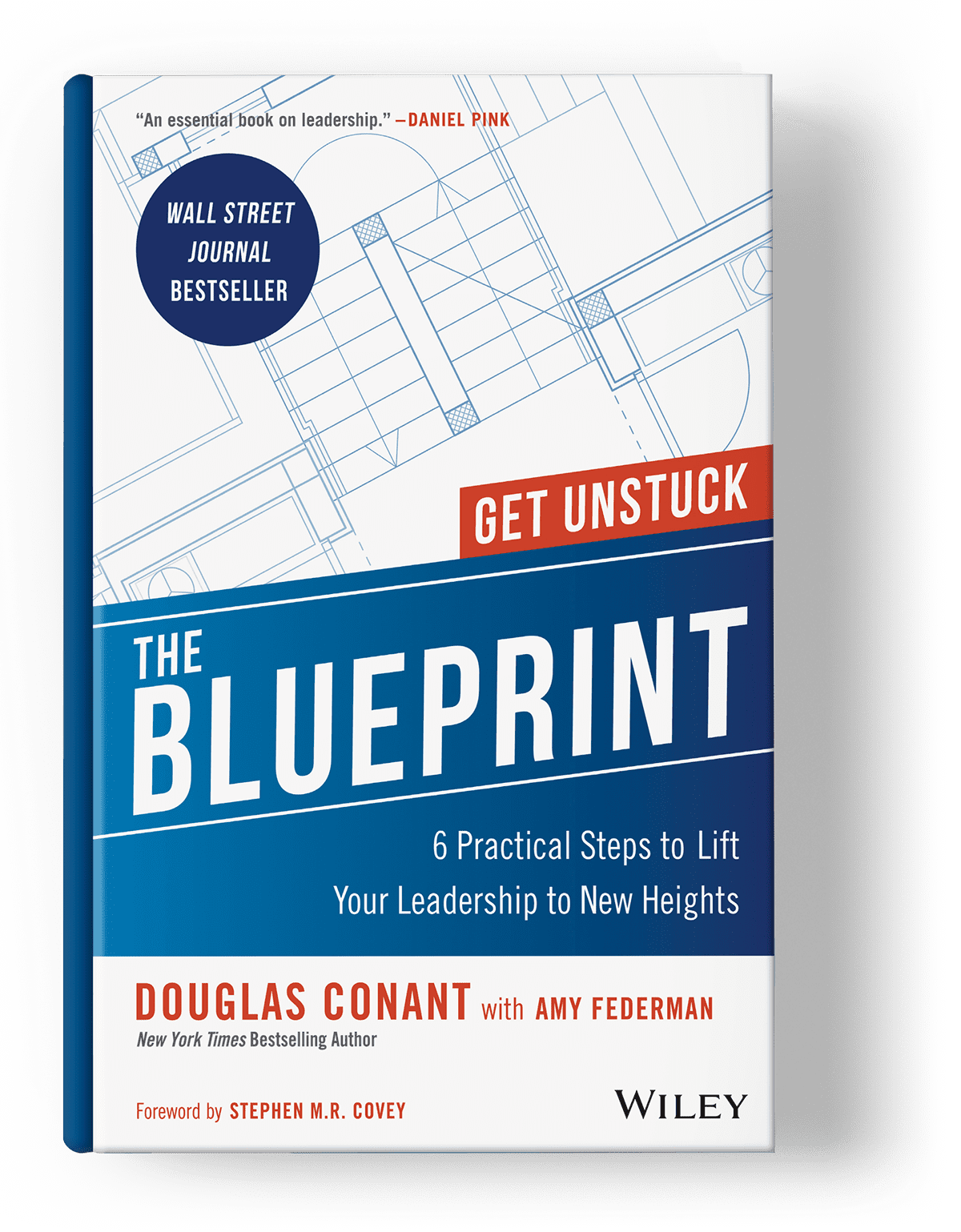
The Blueprint
6 Practical Steps to Lift Your Leadership to New Heights
By Douglas Conant with Amy Federman



Have Doug Speak at Your Event
Doug works collaboratively with event organizers to customize his material for each audience.