
 all resources & insights
Is Optimism the Key to a Long Life? – The Leadership That Works Newsletter
At ConantLeadership, we’re committed to lifelong learning and continuous improvement. In service to your leadership growth, in each month’s ‘Leadership That Works’ newsletter we curate a digest of resources from around the web to:
- Share actionable advice from top leadership luminaries
- Celebrate a range of viewpoints (inclusion is not an endorsement)
- Contextualize workplace trends through a leadership lens
- Support your personal development in life, leadership, & beyond
You can subscribe to our newsletter here.
Want to work with us to lift your or your team’s leadership to new heights? Drop us a line or talk to Emma Anthony, our Director of Leadership Programs.
In this edition of the Leadership That Works Newsletter: The power of optimism, why you should commit to ‘personal learning,’ how to manage yourself, the practice of following your interest, tips for doing ‘hard better,’ and more.
New from ConantLeadership
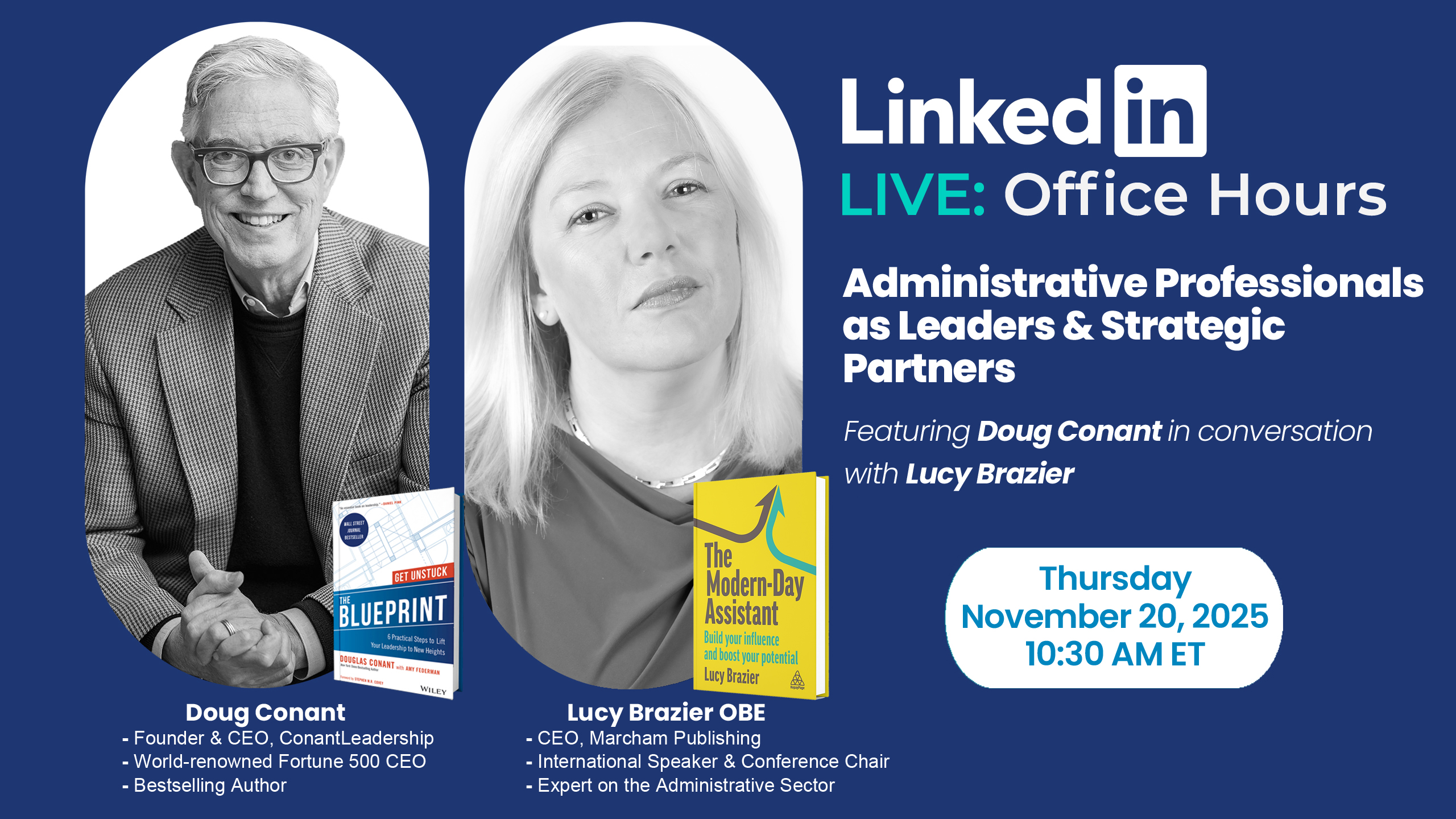 Video Replay: Administrative Professionals as Leaders & Strategic Partners
In this month’s LinkedIn LIVE discussion between Doug Conant and Lucy Brazier OBE, the panelists discussed three key themes:
- The Evolution of the Administrative Profession
- Leadership Without a Title
- The Human Advantage – AI & the Future of Work
This conversation is important for:
- Administrative professionals who are looking for elite-level leadership advice, inspiration, and training
- Executives and HR leaders who are committed to providing top-of-class learning & development solutions to their administrative force
- C-suite leaders and executive assistants who want to learn how to show up for each other more effectively as strategic partners
Watch the full video replay here.
- Additional Resources
Doug shared more information about his groundbreaking new course STEPS, the first leadership program for Administrative Professionals that is inspired by an Executive Assistant and taught by a Fortune 500 CEO. Use code CYBER15 for 15% off through 12/5/25. - Lucy Brazier shared more information about her book, The Modern Day Assistant, her magazine, Executive Support Magazine, and her company, Marcham Publishing—all of which serve the administrative professional community.

Founder’s Corner: What’s Doug Watching & Reading?
A new feature in our newsletter where we highlight a few resources that our Founder & CEO, Doug Conant, has recently found insightful and/or inspiring.
1. ARTICLE: “Why Decency in Leadership Is a Competitive Advantage” by Bill Boulding
From Doug: “I have been a student of leadership over the 50 years of my corporate leadership journey.As such, I’ve been a voracious reader on the subject.Somehow, this 2019 article slipped past me. Thankfully, a participant in a recent Blueprint Boot Camp shared it with me.This piece beautifully reenforces our work at ConantLeadership and, in fact, advances it by calling out ‘decency’ as a key value that naturally supports our mission of ‘Championing Leadership That Works.’Contrary to the practices of some leaders, we contend that this leadership value has never been more important than it is in the current cultural climate.”
2.VIDEO: Kara Lawson – ‘Do Hard Better‘
From Doug: “Love this video from American basketball coach Kara Lawson because it sets the table for a discussion about why we must always be working to ‘lift our leadership to new heights’ and strive for mastery in our leadership craft. It also aligns nicely with one of our key messages from The Blueprint, which is to ‘Forget Perfection.’ We can’t wait for the ‘perfect’ moment to get started on our personal growth and development. The conditions will never be just right. We simply have to begin, take incremental steps, and keep improving, until we can ‘do hard better.'”
3. Three Things I’m Grateful For
From Doug: “It’s always a good time to reflect on what we are grateful for, but it is particularly resonant in the holiday season. In the spirit of the season, I recommend that people write out at least three things they’re grateful for as the year comes to a close. I’ll go first.
1. The opportunity to spend time with my family.
2. The continued engagement of the ConantLeadership community.
3. The hardworking remote ConantLeadership team who brings our suite of leadership resources and training to life every day.”
What about you? What are you grateful for this year?
Is Optimism the Key to a Long Life?
Dick Van Dyke, a beloved cultural icon and star of classic Hollywood-produced TV and movies, is about to turn 100 years old, a milestone achievement. In this New York Times Well newsletter, he shares his secrets for longevity, many of which can also be found in his new book, 100 Rules for Living to 100: An Optimist’s Guide to a Happy Life. While some of his tips for prolonging lifespan are common sense health advice (e.g., staying active and maintaining strong social connections), two of his tips are relevant to leadership too as they hold insights for making work and life more meaningful.
1. Van Dyke stays positive and commits to “playfulness,” which he says “gives you a sense of fun and freedom.” Research also shows that staying upbeat and finding playful “levity” in the everyday reduces stress and boosts wellness.
2. Van Dyke says “yes” to things as often as he can and doesn’t try to battle against a changing world. He says, “You do really have to keep your mind open as you get older, especially to new ideas,” an attitude that keeps his brain nimble, helps him stay present in the here-and-now, and remain ever-adaptable to the future. Get the full story here.
**For more on the power of positive thinking, explore this conversation between Jon Gordon and Doug Conant about how optimism is often a key ingredient to leadership success.
To Innovate, Commit to ‘Personal Learning’
In this Harvard Business Review interview with Poul Weihrauch, CEO of Mars, he imparts an abundance of leadership wisdom on topics like positive social impact, sustainability, and more. One of the hidden gems in the interview is found in response to a question about innovation; Weihrauch shares a simple but counterintuitive answer for how to drive creativity and avoid “getting trapped by legacy thinking.” The key, he says, is “personal learning.”
Says Weihrauch: “I think if you go back and study what really constitutes the most important elements of leadership, the most important is personal learning.” He continues, “You need high curiosity. So it’s incredibly important, as a leader, that you are curious about the world, that you’re curious about people, that you can engage with people and get the best out of people, and that you make sure that you have your tap on a lot of things in society and see where change is coming and going.” If you’re really committed to innovating, Weihrauch’s top piece of advice is to “over-invest in personal learning, both on the content side, and as importantly, on personal development and leadership development.” If you are “curious about the world, about business, about business models,” that will “automatically” lead you to higher ground. Get the full story here. (This piece may appear behind a paywall for some readers.)
Follow Your Interest
In this edition of his The Imperfectionist newsletter, Oliver Burkeman has a reminder for when you’re feeling stuck with work or productivity: “It’s worth asking if you’ve forgotten the importance of building your days, as far as you’re able, around what actually interests you.” He says that while “interest” might be a relatively tepid word compared to “passion” or “excitement,” “interesting” is a practical and useful ideal: “An interesting life – interesting to you, that is, not necessarily to other people – might in fact be the highest and best goal to which any of us could aspire.” And he adds, “to follow the lead of interestingness is to accept that life isn’t a problem to be solved, but an experience to be had. And that engaging with it as fully as possible, connecting to the aliveness, is its ultimate point.”
Yes, Burkeman acknowledges that it’s not necessarily realistic to only perform tasks you deem interesting. But he says you can implement a practice “of daring to trust your own curiosity” more often and seeing where that takes you. You may find that trying to follow your interest when you can, as an operating principle, leads to more resilience too: “Meaningful projects aren’t always fun; life certainly isn’t always easy; and the moment in history through which we’re living definitely isn’t calming and relaxing. But maybe it is always, or almost always, possible to find and pursue something that’s truly and enliveningly interesting about the place in life in which you find yourself.” Get the full story here.
Manage Yourself
“Your life is the most important management task you will ever undertake,” says author Arthur Brooks in this Greater Good Magazine interview. This is aligned with one of the central precepts in our book, The Blueprint: “Your life story IS your leadership story,” meaning that deeper self-knowledge is the necessary foundation to support any sky-high aspiration. Brooks explains that he views it similarly: “You don’t have to leave your life up to chance. There are lots and lots of uncertainties in life, to be sure. There is lots of risk in your life. There’s a lot of unknowns in your life . . . but fundamentally, you don’t have to leave the big things up to chance.” To take control of the task of self-management means being more intentional about pursuing self-knowledge. Brooks further explains this need to go deeper within, “Your life doesn’t have to manage you. You can manage your life, but you have to know how it works, and that’s the task at hand.” Get the full story here.
More from ConantLeadership
 Now Available: The STEPS Leadership Course for Administrative Professionals
Inspired by Doug’s Executive Assistant, Diana Hansen, and taught by Doug himself, a Fortune 500 CEO, this groundbreaking leadership course teaches the same 6-step BLUEPRINT process we use to train senior executives, customized for the true engine of the C-Suite: Administrative Professionals and Executive Assistants.
This is leadership training powerful enough for the boardroom, but optimized for every room you’re in. No more gatekeeping leadership skills. We’re taking elite-tier leadership training out of the corner office and into your living room, with accessible, self-paced, online programming built for real life.
>>Learn more about the course
>>Now through Dec. 5th use code CYBER15 for 15% off registration
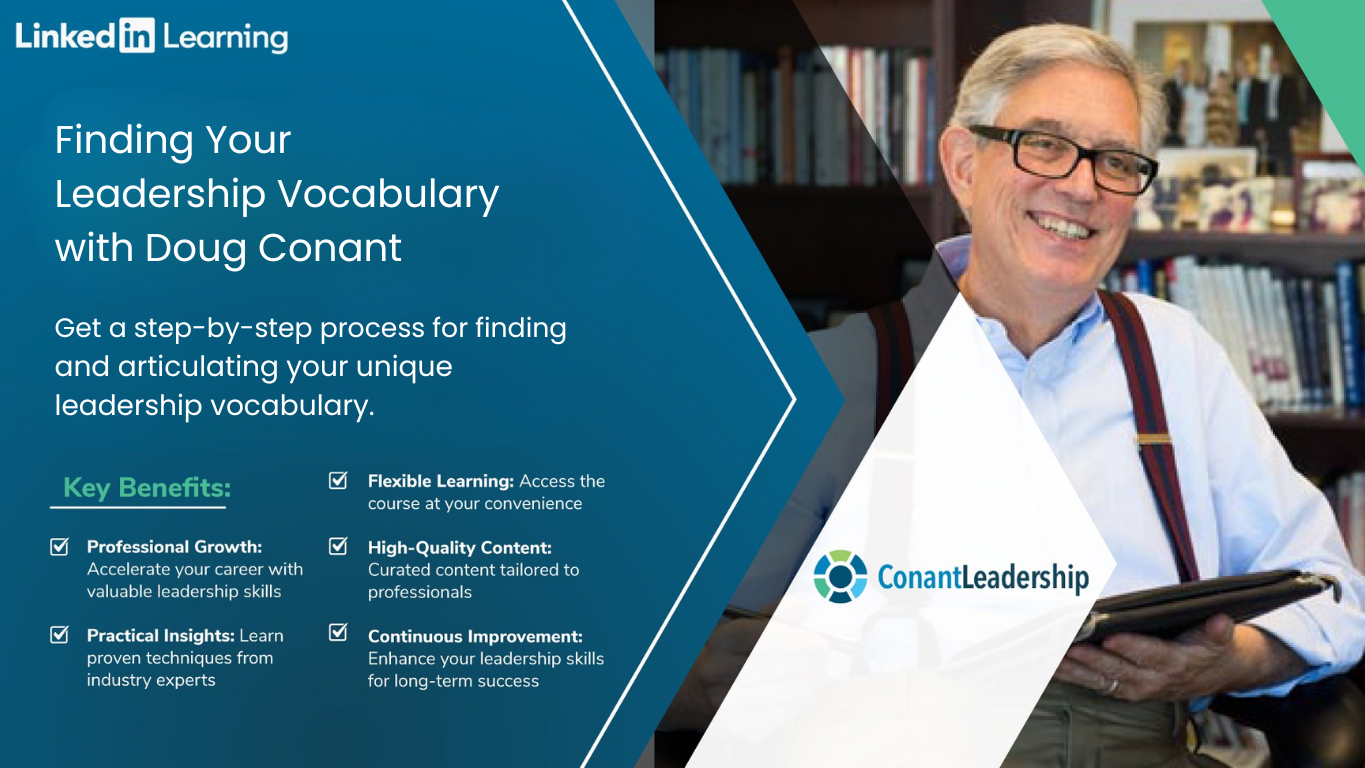 NEW LinkedIn Learning Course: Finding Your Leadership Vocabulary with Doug Conant
In this follow-up to our first LinkedIn Learning course, Finding Your Leadership Purpose with Doug Conant, (which has reached over 88,500 learners), join Doug in this new learning pathway as he guides you through the important work of articulating your leadership beliefs and crystallizing them into a Leadership Vocabulary that you can use to influence others more effectively.
Drawing from years of experience as a top executive and the president and CEO of Campbell Soup Company, Doug teaches you how to lead with authenticity, motivate people, and express your leadership vision with greater impact. Through a series of practical exercises and real-world examples, this course gives you a chance to create your own leadership vocabulary aligned with your core values and beliefs. Check out the new course here.
Lead with Gratitude
In this piece from 2019, now newly updated for 2025, ConantLeadership Founder & CEO, Doug Conant, reflects on crucible moments from his life and career and reframes them as opportunities for learning and growth, a practice he says is central to having a “gratitude mindset.” Get the full story here.
October’s Leadership That Works Newsletter
In last month’s newsletter: Finding your leadership vocabulary, culture starts at the top, don’t get too ‘cozy,’ the DiSSS method for learning new things, and more.
 About the Author: Amy Federman is ConantLeadership’s Director of Content and Editor in Chief, and co-author with Doug Conant of the WSJ bestseller, The Blueprint.
(Header photo by Daniele Franchi on Unsplash)

“Doug Conant is remarkable—and so is this work.“
– Stephen M. R. Covey
Author of The Speed of Trust
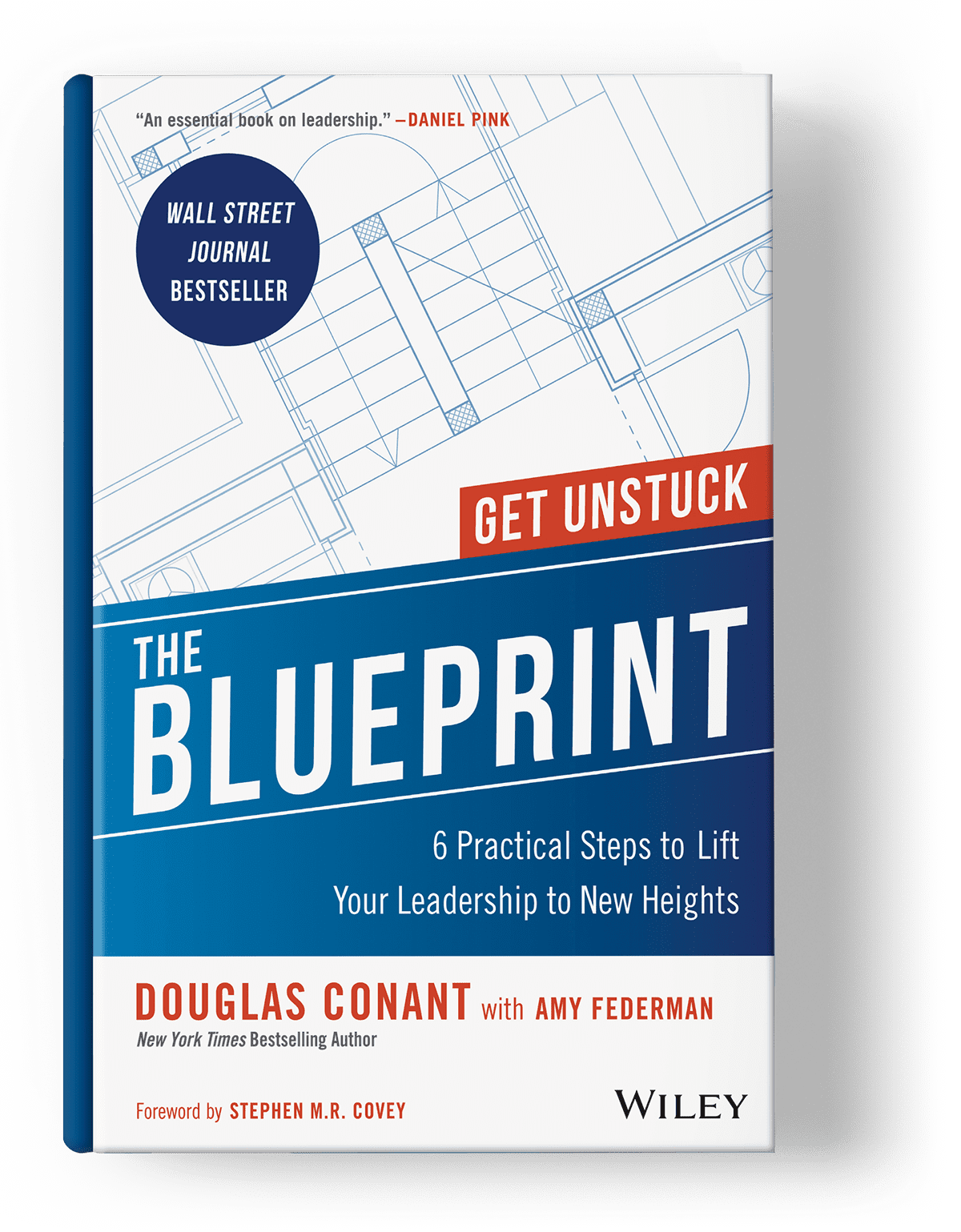
The Blueprint
6 Practical Steps to Lift Your Leadership to New Heights
By Douglas Conant with Amy Federman


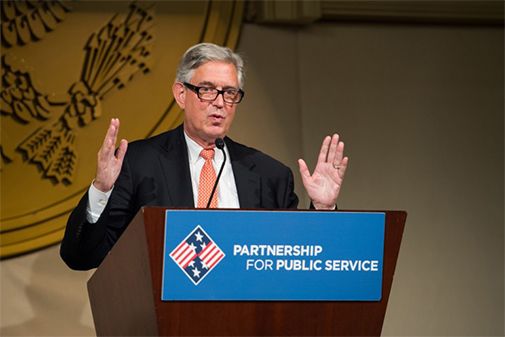
Have Doug Speak at Your Event
Doug works collaboratively with event organizers to customize his material for each audience.
0 Comments