
 all resources & insights
Culture Starts at the Top – The Leadership That Works Newsletter
At ConantLeadership, we’re committed to lifelong learning and continuous improvement. In service to your leadership growth, in each month’s ‘Leadership That Works’ newsletter we curate a digest of resources from around the web to:
- Share actionable advice from top leadership luminaries
- Celebrate a range of viewpoints (inclusion is not an endorsement)
- Contextualize workplace trends through a leadership lens
- Spread the latest ConantLeadership news and resources
- Support your personal development in life, leadership, & beyond
You can subscribe to our newsletter here.
Want to work with us to lift your or your team’s leadership to new heights? Drop us a line or talk to Emma Anthony, our Director of Leadership Programs.
In this edition of the Leadership That Works Newsletter: Finding your leadership vocabulary, culture starts at the top, don’t get too ‘cozy,’ the DiSSS method for learning new things, and more.
New from ConantLeadership
 Announcing Our New LinkedIn Learning Course: Finding Your Leadership Vocabulary with Doug Conant
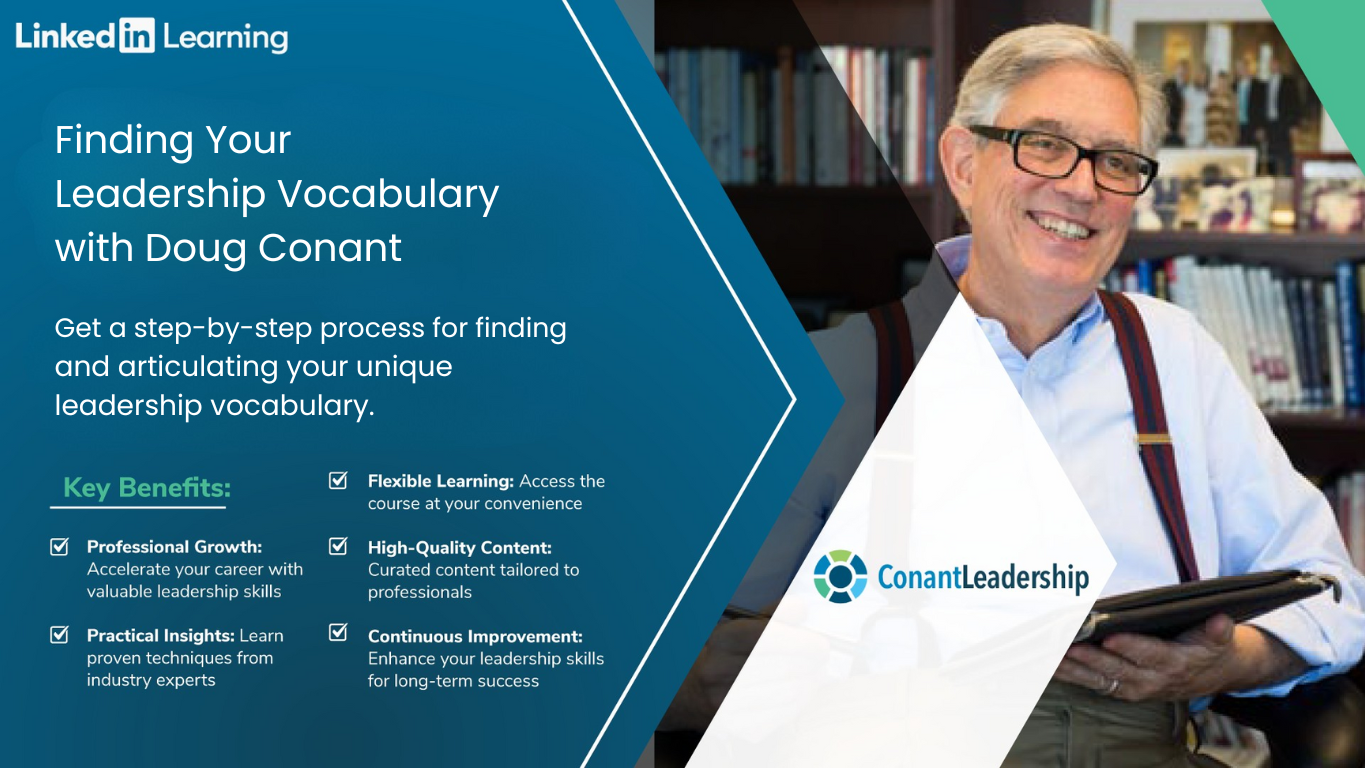
In this follow-up to our first LinkedIn Learning course, Finding Your Leadership Purpose with Doug Conant, (which has reached over 88,500 learners), join Doug in this new learning pathway as he guides you through the important work of articulating your leadership beliefs and crystallizing them into a Leadership Vocabulary that you can use to influence others more effectively.
Drawing from years of experience as a top executive and the president and CEO of Campbell Soup Company, Doug teaches you how to lead with authenticity, motivate people, and express your leadership vision with greater impact.
Through a series of practical exercises and real-world examples, this course gives you a chance to create your own leadership vocabulary aligned with your core values and beliefs.
By the end of these modules, you’ll be equipped with the skills you need to communicate your leadership philosophy clearly and inspire high performance in your teams and organizations.
Check out the new course here.
Drawing from years of experience as a top executive and the president and CEO of Campbell Soup Company, Doug teaches you how to lead with authenticity, motivate people, and express your leadership vision with greater impact.
Through a series of practical exercises and real-world examples, this course gives you a chance to create your own leadership vocabulary aligned with your core values and beliefs.
By the end of these modules, you’ll be equipped with the skills you need to communicate your leadership philosophy clearly and inspire high performance in your teams and organizations.
Check out the new course here.

ConantLeadership Founder & CEO, Doug Conant
Founder’s Corner: What’s Doug Watching & Reading?
A new feature in our newsletter where we highlight a few resources that our Founder & CEO, Doug Conant, has recently found insightful and/or inspiring.
1. BOOK: Leading with Aliveness by Mette Norgaard
From Doug: “I have known Mette for the better part of three decades. We have taught leadership together, authored a NYT best-selling book, TouchPoints, together, broken bread together, and shared some amazing experiences, a few of which are chronicled in her new book, Leading With Aliveness. One of the joys of my work life has been exploring the nooks and crannies of leadership with her. Her perspective has always enriched my learning, and I know it will do the same for you.”
2. BOOK: Leadership Toolkit for Asians by Jane Hyun
From Doug: “Jane has been an inspiration to me for quite some time. Her work is important and tangibly helps build higher-performing, diverse organizations. This book, while developed to speak particularly to Asians, is helpful and practical for leaders across backgrounds. I recommend it.“
3. BOOK: Strong Ground by Brené Brown
From Doug: “I recently started reading Brené ‘s latest book on “the lessons of daring leadership, the tenacity of paradox, and the wisdom of the human spirit,” and it’s no surprise to me that her thinking is very aligned with my own. She really gets it. Lots to uncover for leaders of all stripes.”
For some bonus material, re-visit Doug’s appearance on Brené Brown’s podcast, where they talk about finding and telling your leadership story.
4. ARTICLE: “From Words to Action: Leading with Purpose in a Shifting Landscape” by Daryl Brewster
From Doug: “The key challenge for leaders today is to craft a values-driven team and enterprise purpose that transcends the ordinary and then to consistently bring it to life in tangible ways in the here-and-now. Daryl Brewster, CEO of CECP, illustrates this well in this piece.“
‘CEO of the Year’ Says Culture Starts at the Top
In this interview with Chief Executive‘s newly crowned ‘CEO of the Year,’ Dave Ricks, who has steered Eli Lilly “into the most valuable pharmaceutical outfit in history,” he imparts many leadership gems. Some of the most illuminating passages come from Ricks’ insights about the paramount importance of company culture, which he says, is a job “only the CEO can do,” meaning the tone must be set at the top. He says one of the most powerful tests of company culture is “how you react when things go wrong.” And he challenges CEOs to lead by example, saying the most effective leaders “act with integrity, pursue the mission of the company, put the interests of customers first,” and they do those things even when under pressure and in tough conditions. Ricks says it’s in the most challenging moments that people notice if a CEO is a person of their word, and they absorb the leader’s cues about the behavioral model for the organization and internalize them. Overall, he says: “Culture is formed by doing the work and then, as a leader, leading the work in a way that creates a pattern people can see that is successful and they follow themselves.” Get the full story here.
**For more insights on how top CEOs create winning cultures, explore this conversation between Bill George and Doug Conant, which explains that the best leaders are both “tough-minded on standards and tender-hearted with people.”
Leaders, Don’t Get Too ‘Cozy’
“Everyone has a choice in life. You can either be cozy—or you can fly,” says Kellogg School senior fellow Sanjay Khosla in this KelloggInsight piece on how to stay sharp in a competitive landscape. Khosla’s warning is: “Being cozy is dangerous because it lulls people and organizations into repeating what once worked, even as the world around them changes.” He shares four tips for recognizing when coziness has turned into complacency—and how to turn things around.
1. Focus on the future. “One hallmark of being cozy is clinging to what worked yesterday . . . what worked yesterday may be the very thing that prevents growth tomorrow. So leaders have to be brutally honest with themselves about the life cycles of even their most reliable products and processes.”
2. Dare to dream big. “If getting ready to fly means looking forward and avoiding assumptions about what has worked in the past, it also means summoning the courage to act decisively. Flying requires setting audacious targets and empowering teams to pursue them.”
3. Disrupt yourself (before others do). “To fly, you also need the courage to break your own rules . . . the upside of disrupting your business model is that you can unlock new growth.” He adds, “while disruption feels very risky, that is where real breakthroughs come from.”
4. Gather diverse opinions. “Not every attempt to fly will succeed. Leaders should read every decision with an eye on when to double down and when to walk away. In the process, they should seek as much input as possible.” Khosla recommends what he calls a “Discovery Workshop,” which is “a series of discussions that begin by opening the floor to a wide range of ideas before then narrowing those ideas down to the most-promising options.”
Get the full story here.
Don’t ‘DiSSS’ this Method for Learning New Skills
“As technology advances, skills are becoming more obsolete at an alarming rate,” and, “to remain competitive in your career or simply maintain your brain’s sharpness, you need a reliable way of learning,” writes Deanna Ritchie in this Calendar coverage of Tim Ferriss’s DiSSS Method. The DiSSS method is devised to overcome the most common roadblocks to effective learning, which are “overwhelm,” “inefficient practice,” and “lack of consistency.” There are four steps.
1.Deconstruction—break it down. “The deconstruction of a skill involves breaking it down into its smallest attainable components.” Making a big task smaller helps you to “stop seeing an overwhelming mountain and start seeing manageable steps.”
2. Selection —focus on what matters most. “As soon as you’ve broken down a skill into smaller parts,” you can start prioritizing the components. “A common trap is believing that you must know everything before you can get started,” but it’s better to create a focused plan of initial attack.
3. Sequencing—put it in the right order. “Here, you should arrange your learning in a manner that logically builds on each other. As a result, frustration is prevented and mastery is accelerated . . . by following the correct sequence, you can achieve quick wins and establish a solid foundation for deeper learning.”
4. Stakes—create accountability. “The truth is, most people don’t quit because they can’t learn new skills. They quit because nothing is at stake. When motivation is lacking, it tends to fade away. To keep yourself moving, you need to create consequences and rewards. . . even small stakes can make a significant difference.”
Get the full story here.
**For more on this, explore our 6-step BLUEPRINT process for lifting your leadership to new heights, which focuses on breaking down the craft of leadership into small, incremental steps to help you achieve breakthrough.
Beware the Rise of AI-Generated ‘Workslop’
In this piece in The Conversation, business school professors Steven Lockey and Nicole Gillespie sound the alarm about a rising scourge of AI ‘workslop’ that, contrary to AI’s promise of streamlining and turbo-charging workstreams, is actually slowing productivity. The authors cite their research which shows “a staggering two-thirds (66%) of employees who use AI at work have relied on AI output without evaluating it” for accuracy. This lack of quality control “can create a lot of extra work for others in identifying and correcting errors, not to mention reputational hits.”
The authors use a term that has entered the workplace lexicon to help describe this troubling phenomenon: “Workslop,” which refers to “AI-generated content that looks good,” at least on a surface level, “but lacks the substance to meaningfully advance a given task.” Workslop often presents with a veneer of legitimacy but its content is not useful or applicable; it can show up in the form of grammatically correct, yet vapid sentences, slung together in a document, ultimately signifying nothing. The authors warn that “beyond wasting time, workslop also corrodes collaboration and trust.” But it’s not all doom and gloom. They say that AI, “when applied to the right tasks, with appropriate human collaboration and oversight,” can enhance performance. And it’s up to all of us to get it right. Get the full story, including recommendations for both employers and employees in battling AI workslop and creating AI strategies, here.
More from ConantLeadership

NOW AVAILABLE: The New STEPS Leadership Course for Administrative Professionals
It’s time to STEP into your power: Inspired by Doug’s Executive Assistant, Diana Hansen, and taught by Doug himself, a Fortune 500 CEO, this groundbreaking leadership course teaches the same 6-step BLUEPRINT process we use to train senior executives, customized for the true engine of the C-Suite: Administrative Professionals and Executive Assistants.
For too long, administrative professionals have been the secret to the organization’s success. Now, the secret’s out. This is leadership training powerful enough for the boardroom, but optimized for every room you’re in. No more gatekeeping leadership skills. We’re taking elite-tier leadership training out of the corner office and into your living room, with accessible, self-paced, online programming built for real life.
>>Learn more about the course
>>For a limited time, use code LAUNCH10 for 10% off registration
In Doug Conant’s past conversation with Dan Pink, author of multiple bestselling books on leadership and human behavior, the two panelists share the evidence-based ways to plan your day for maximum impact.
**For more from these panelists, you can access a video replay of Doug’s most recent conversation with Dan Pink, on the power of regret, here.
**For more from these panelists, you can access a video replay of Doug’s most recent conversation with Dan Pink, on the power of regret, here.
September’s Leadership That Works Newsletter
In last month’s newsletter: Five crucial conversations, what Doug’s reading and watching, lessons from Costco on enduring success, the ‘RULER’ framework, what makes a ‘contemplative leader,’ the ethics of the AI race, and more.
 About the Author: Amy Federman is ConantLeadership’s Director of Content and Editor in Chief, and co-author with Doug Conant of the WSJ bestseller, The Blueprint.
(Header photo by Philippe BONTEMPS on Unsplash)

“Doug Conant is remarkable—and so is this work.“
– Stephen M. R. Covey
Author of The Speed of Trust
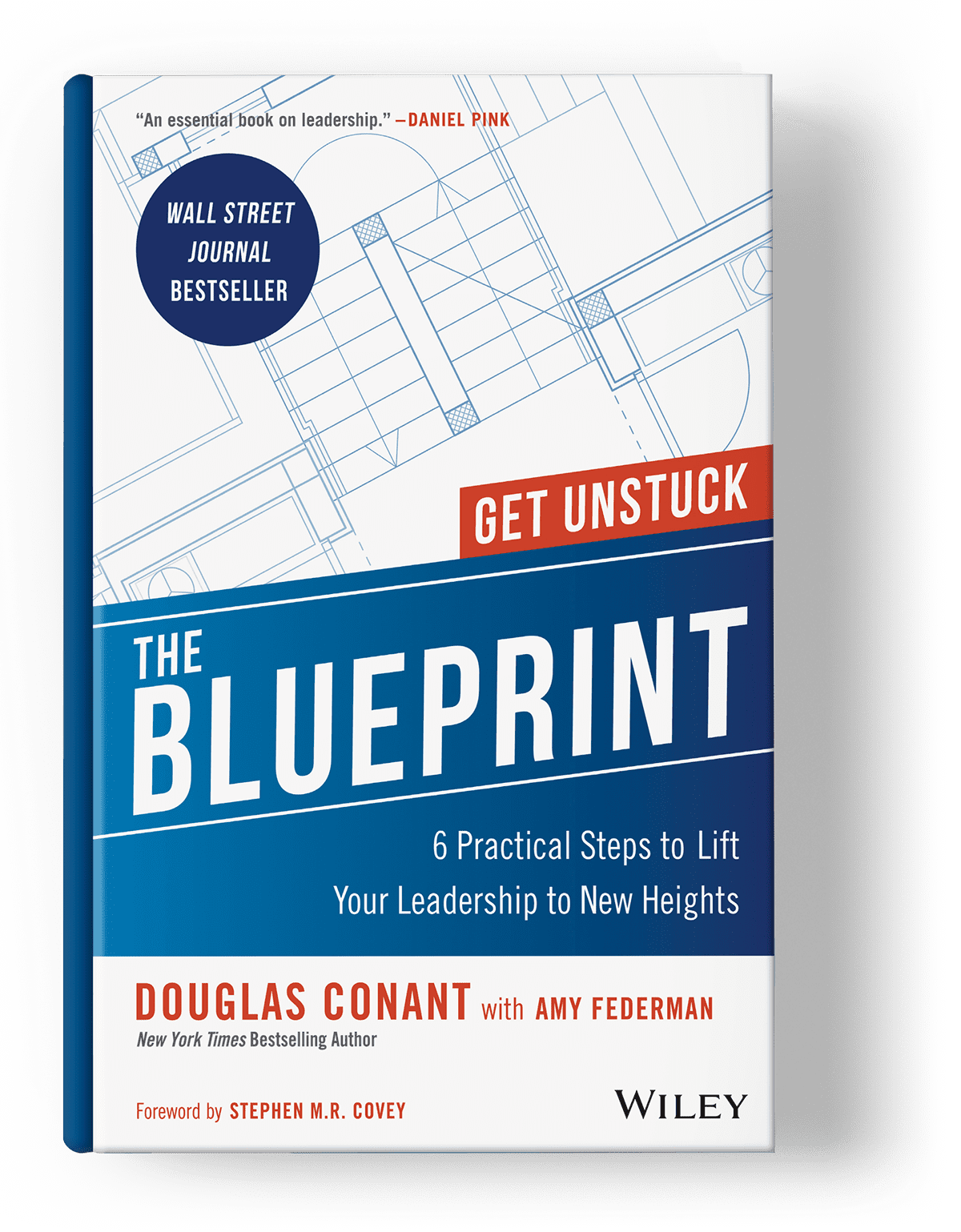
The Blueprint
6 Practical Steps to Lift Your Leadership to New Heights
By Douglas Conant with Amy Federman



Have Doug Speak at Your Event
Doug works collaboratively with event organizers to customize his material for each audience.
0 Comments